Online
 Spanish
 Free
Free

You have probably thought more than once, “I’m just not good at Statistics”… but that is not true. You simply have not found someone who motivates you, someone who presents things in an accessible and friendly way. Our goal is to do that for you. And if we do not succeed, then we will have to be the ones saying, “I’m just not good at teaching Statistics”… but that is not going to happen! You are capable of learning Statistics, and we are capable of teaching it to you. WE ARE SURE OF IT.
Do not hesitate to ask questions, do not leave any doubts unresolved, take part in the forums, and generate discussions. We do not want you to feel alone; we are here, very close and very attentive, to make sure everything goes well. Learn not only from us, but also from the large community taking part. Several thousand researchers, working together, will make this course an unforgettable experience. Thank you for participating and making the first MOOC of the honorable University of Salamanca a reality. Without you, it would not have been possible.
The program of statistics courses presented here is an expanded and improved revision of the successful MOOC Statistics for Researchers, which attracted more than 50,000 researchers from 53 countries around the world and received a Special Mention in the 1st Ibero-American Miríada X – SEGIB Award, in 2103.
General objective of the program
- To introduce researchers, in accessible language, to the basic tools of statistical data analysis, enabling them to understand the statistical methodology used in scientific publications and correctly interpret computer output in order to include statistical analyses in their work.
Specific objectives of the Courses
- Organize data in summary tables and present them in statistical graphs.
- Correctly interpret a basic descriptive statistics output (measure of central tendency and corresponding measure of dispersion).
- Determine whether there is a relationship between two or more quantitative variables and know how to evaluate the model that describes the relationship and its goodness of fit.
- Recognize whether there is a statistically significant relationship between two or more qualitative variables and, if so, identify the causes of the significance.
- Evaluate whether there is a significant relationship between a qualitative variable and a quantitative variable, or between several qualitative and quantitative variables, and distinguish how the analysis should be carried out depending on whether the sample is large or small and according to the nature of the data (normal or not).
Methodology
These courses will feature various types of activities (discussion forums, Q&A forums, and assessment quizzes), as well as materials to help and guide you in your statistical learning: videos (several per course) that serve as the backbone of the content; theoretical “frequently asked questions” documents—covering the questions every researcher asks—along with their answers; and supplementary material (we don’t think it’s necessary, but it’s always a good idea to have references you can consult).
Speakers
Purificación Galindo Villardón
University of Salamanca
María Purificación Vicente Galindo
University of Salamanca
Course type: [B] basic course; Level 1 elective courses [O1] and Level 2 elective courses [O2]
Importance of Statistics in Life [B]
-
Masterclass
"Statistics for Researchers: Importance of Statistics in Life"
Purificación Galindo Villardón, University of Salamanca -
Invitation video Video link
"Introduction and Welcome to 'Statistics for Researchers'"
Purificación Galindo Villardón, University of Salamanca -
Live session Online Masterclass 28/07/2022 - 12:00pm (Madrid time) Event link
"Importance of Statistics in Life"
Purificación Galindo Villardón, University of Salamanca
Descriptive Statistics [O1]
Analysis of the Relationship Between Quantitative Variables I [O1]
Analysis of the Relationship Between Quantitative Variables II [O2]
Analysis of the Relationship Between Qualitative Variables I [O1]
Analysis of the Relationship Between Qualitative Variables II [O2]
Analysis of the Relationship Between Two Variables, One Qualitative and One Quantitative [O1]
Analysis of the Relationship Between Qualitative and Quantitative Variables [O2]
Nonparametric Tests: Mann-Whitney U and Wilcoxon Test [O1]
The Professional Certificates offered by executives and experts from leading universities and companies aim to meet people's training needs by helping them acquire the professional skills most in demand today.
All certificates can be requested in the formats available at https://e4you.org/es/certificados
In this program, you can obtain three types of certifications:
-
Diploma and ‘Advanced Diploma’: general or comprehensive certificates awarded upon successful completion of a program or qualification. To obtain this type of certificate, it is necessary to:
-
Have completed the basic training [B] and passed all mandatory Level 1 courses [O1] for the Diploma, and also all Level 2 courses [O2] for the ‘Advanced Diploma’.
-
Have obtained all certificates of completion for the mandatory courses defined for each type of diploma.
-
-
Block Diploma (or ‘BLOC © Diploma’): Certificate awarded upon successful completion of all courses in a block or course ‘pack’.
-
To obtain this diploma, it will be necessary to have successfully completed the courses included within the training block and obtained their certificates of completion.
-
-
Course Certificate: Certificate awarded upon successful completion of a course. To obtain this certificate, it will be necessary to view at least 70% of the syllabus and successfully complete the defined course assessment activities (questionnaires, assignment submissions, ...). You will find all the required information within the course.
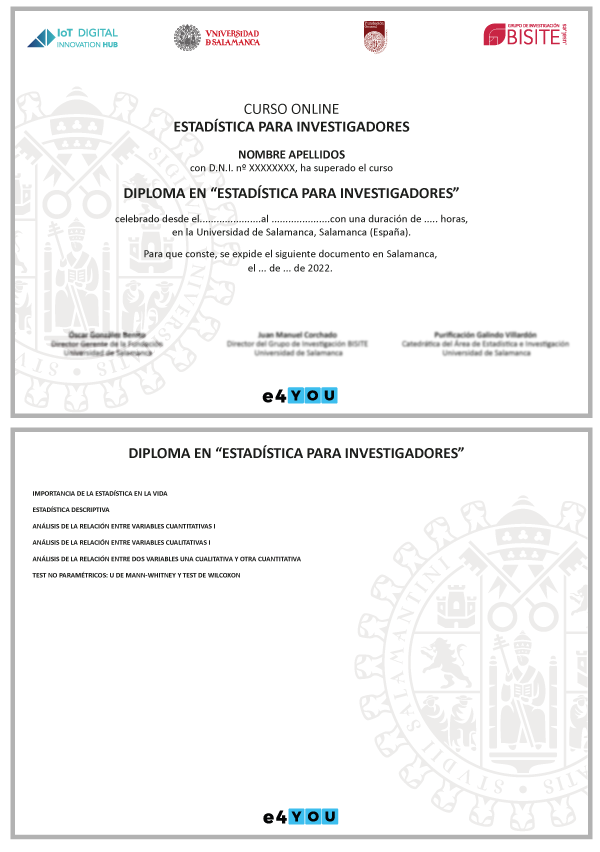
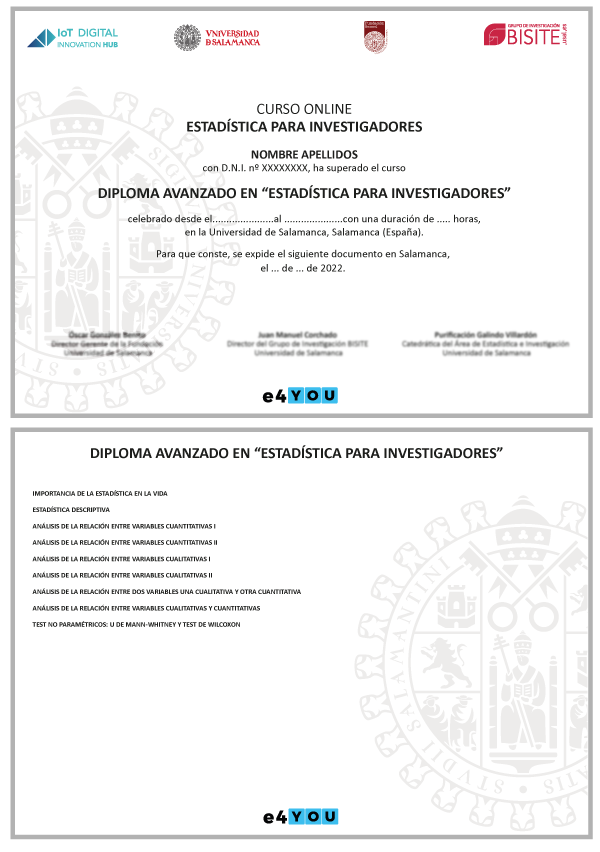
Diploma and ‘Advanced Diploma’:
Diploma in
"Statistics for Researchers"
Certificate you can obtain if you successfully complete:
- All mandatory Level 1 courses [O1]
Advanced Diploma in
"Statistics for Researchers"
Certificate you can obtain if you successfully complete:
- All mandatory Level 1 courses [O1]
- All mandatory Level 2 courses [O2]
Block diplomas or certificates (‘BLOC © Diploma’) offered:
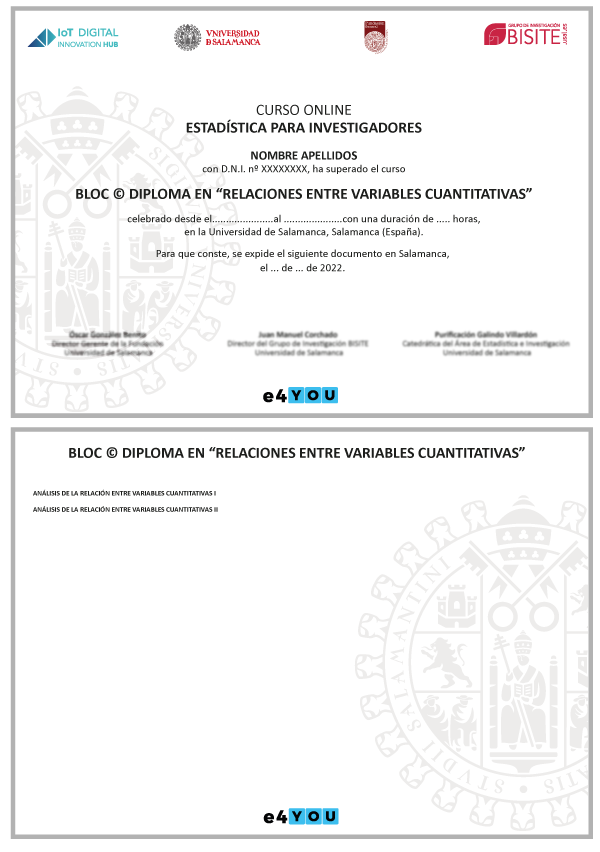
BLOC © Diploma in
"Relationships Between Quantitative Variables"
Certificate you can obtain if you successfully complete the following courses:
- Analysis of the relationship between quantitative variables I.
- Analysis of the relationship between quantitative variables II.
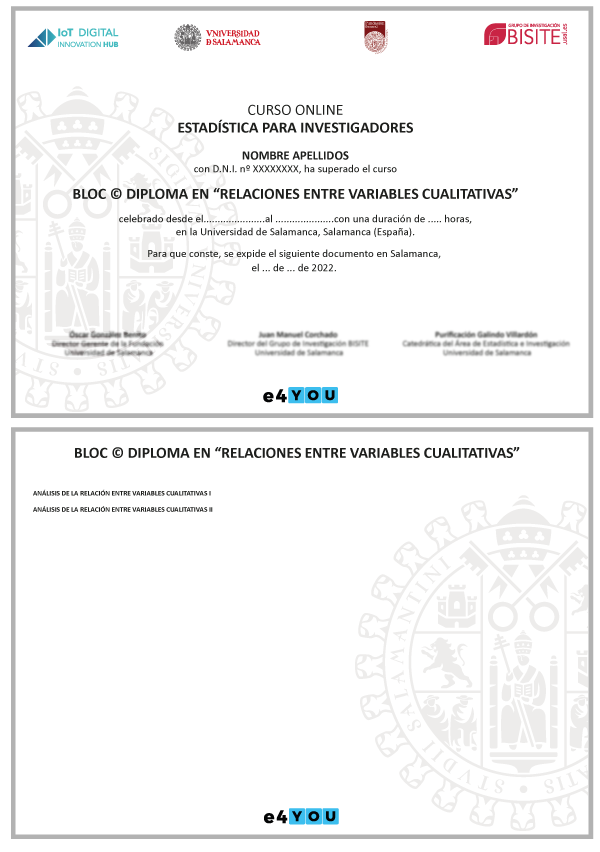
BLOC © Diploma in
"Relationships Between Qualitative Variables"
Certificate you can obtain if you successfully complete the following courses:
- Analysis of the relationship between qualitative variables I.
- Analysis of the relationship between qualitative variables II.
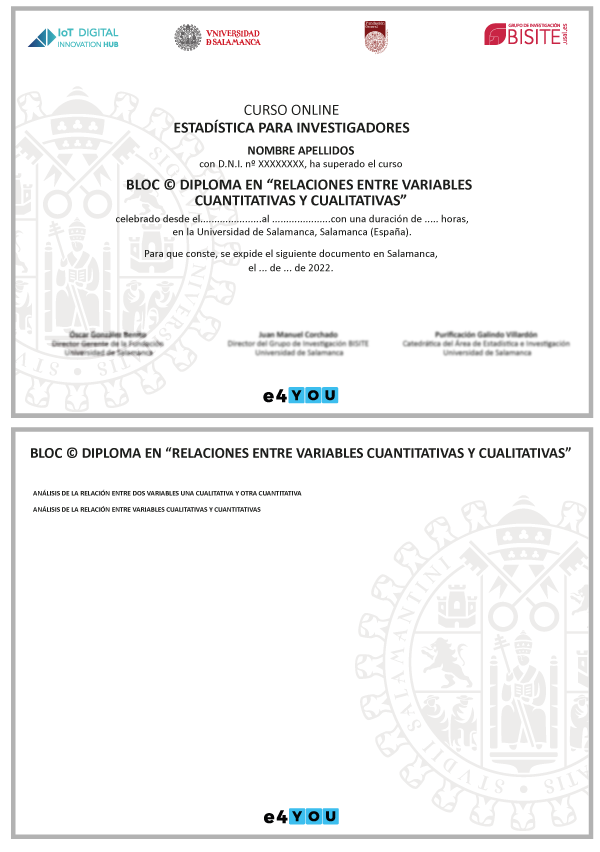
BLOC © Diploma in
"Relationships Between Quantitative and Qualitative Variables"
Certificate you can obtain if you successfully complete the following courses:
- Analysis of the relationship between two variables, one qualitative and one quantitative.
- Analysis of the relationship between quantitative and qualitative variables.
Course certificates offered:
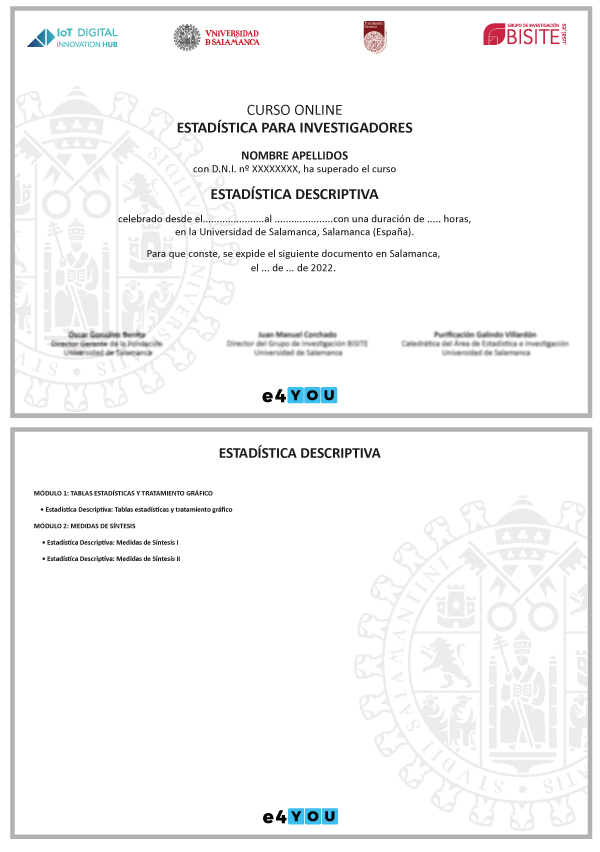
Course Certificate "Descriptive Statistics"
- Each course in the program offers its own certificate. The certificate from one of the courses is used as an example.
Keywords: statistics, researchers, statistical methodology, research, higher education, descriptive statistics, correlation, regression, chi-square test, Student's t-test, nonparametric tests.
Brief description:
The authors of the course program, Puri Galindo Villardón and Puri Vicente Galindo, both professors in the Department of Statistics at the University of Salamanca, present "Statistics for Researchers", courses created in the hope that they will be interesting, but above all, useful for your research.
In this introductory course, they will invite us to learn with them, beginning with the "Masterclass. Importance of Statistics in Life".