Online
 Spanish
 Free
Free

This course is part of Statistics for Researchers.
- This training activity is divided into 2 sections on the analysis of the relationship between qualitative variables within the field of statistics for researchers.
- All students who take the course may request the "Certificate of Attendance" in digital format from the BISITE Research Group of the University of Salamanca, Air Institute Foundation and the IoT Digital Innovation Hub, free of charge. Those who wish to obtain a “Certificate of Completion”, “Advanced Diploma” or “Block Diploma” from the BISITE Research Group, General Foundation of the University of Salamanca and the University of Salamanca, IoT Digital Innovation Hub and the Air Institute Foundation, may also request it in digital or printed format.
Speakers
Purificación Galindo Villardón
University of Salamanca
María Purificación Vicente Galindo
University of Salamanca
Causes of Significance
-
Masterclass Duration: 19min
"Chi-Square Test"
Purificación Galindo Villardón, University of Salamanca -
Masterclass Duration: 17min
"Chi-Square Test: Identifying the Causes of Significance"
Purificación Galindo Villardón, University of Salamanca
The Professional Certificates offered by executives and experts from leading universities and companies aim to meet people's training needs by helping them acquire the professional skills most in demand today.
All certificates can be requested in the formats available at https://e4you.org/es/certificados
In this program, you can obtain three types of certifications:
-
Diploma and ‘Advanced Diploma’: general or comprehensive certificates awarded upon successful completion of a program or qualification. To obtain this type of certificate, it is necessary to:
-
Have completed the basic training [B] and passed all mandatory Level 1 courses [O1] for the Diploma and also all Level 2 courses [O2] for the ‘Advanced Diploma’.
-
Have obtained all certificates of completion for the mandatory courses defined for each type of diploma.
-
-
Block Diploma (or ‘BLOC © Diploma’): Certificate awarded upon successful completion of all courses in a block or course ‘pack’.
-
To obtain this diploma, it will be necessary to have successfully completed the courses included within the training block and obtained their certificates of completion.
-
-
Course Certificate: Certificate awarded upon successful completion of a course. To obtain this certificate, it will be necessary to view at least 70% of the syllabus and successfully complete the defined course assessment activities (questionnaires, assignment submissions, ...). You will find all the required information within the course.
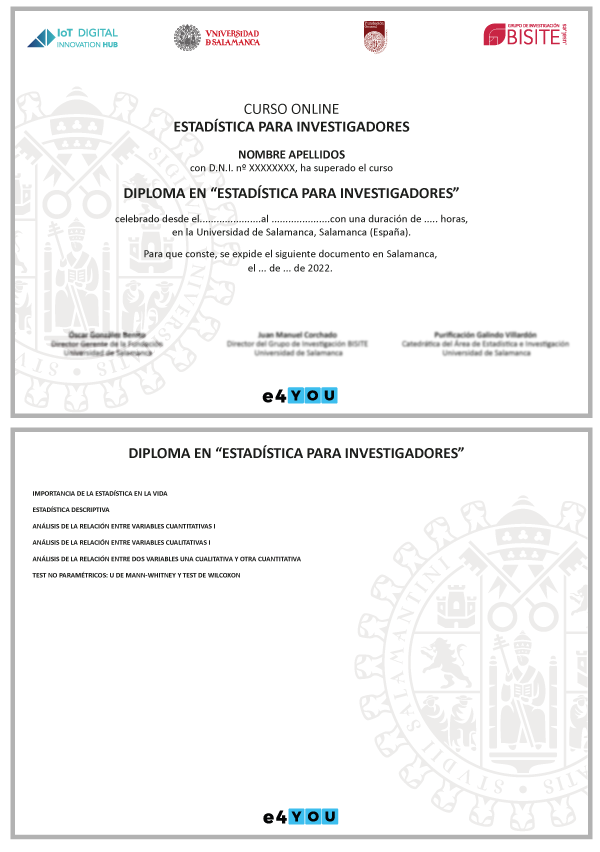
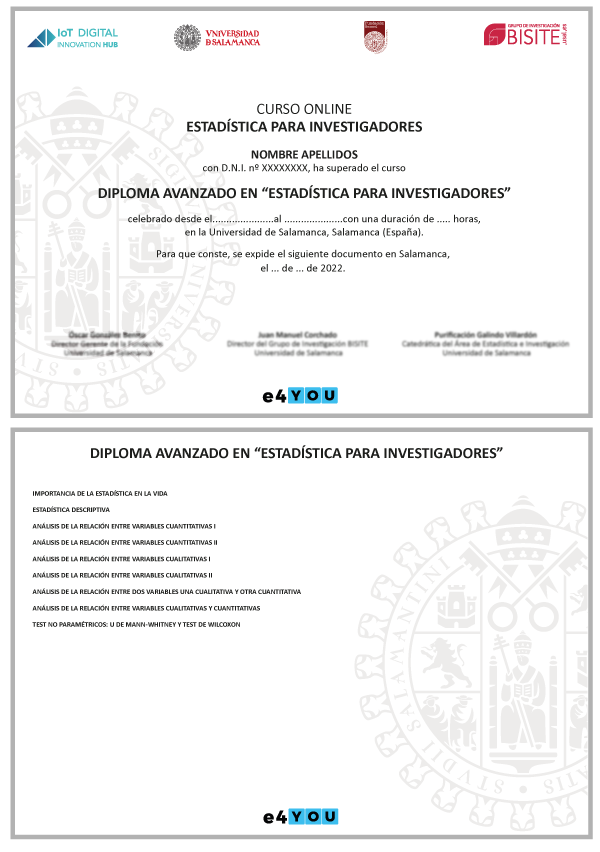
Diploma and ‘Advanced Diploma’:
Diploma in
"Statistics for Researchers"
Certificate you can obtain if you successfully complete:
- All mandatory Level 1 courses [O1]
Advanced Diploma in
"Statistics for Researchers"
Certificate you can obtain if you successfully complete:
- All mandatory Level 1 courses [O1]
- All mandatory Level 2 courses [O2]
Block diplomas or certificates (‘BLOC © Diploma’) offered:
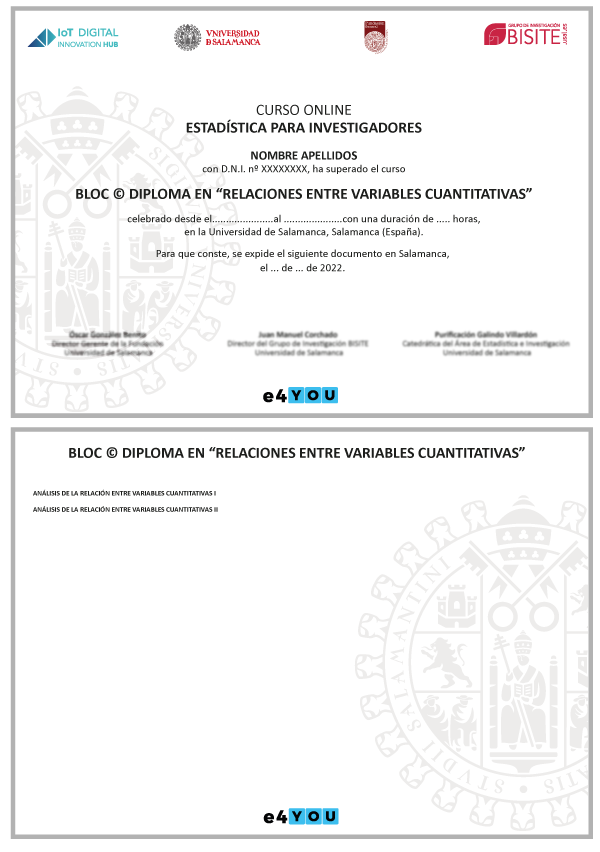
BLOC © Diploma in
"Relationships Between Quantitative Variables"
Certificate you can obtain if you successfully complete the following courses:
- Analysis of the relationship between quantitative variables I.
- Analysis of the relationship between quantitative variables II.
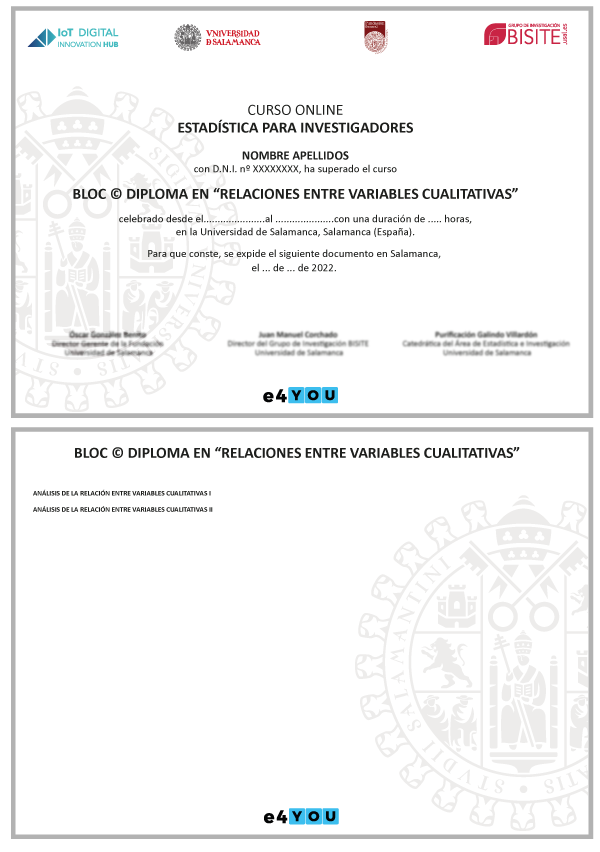
BLOC © Diploma in
"Relationships Between Qualitative Variables"
Certificate you can obtain if you successfully complete the following courses:
- Analysis of the relationship between qualitative variables I.
- Analysis of the relationship between qualitative variables II.
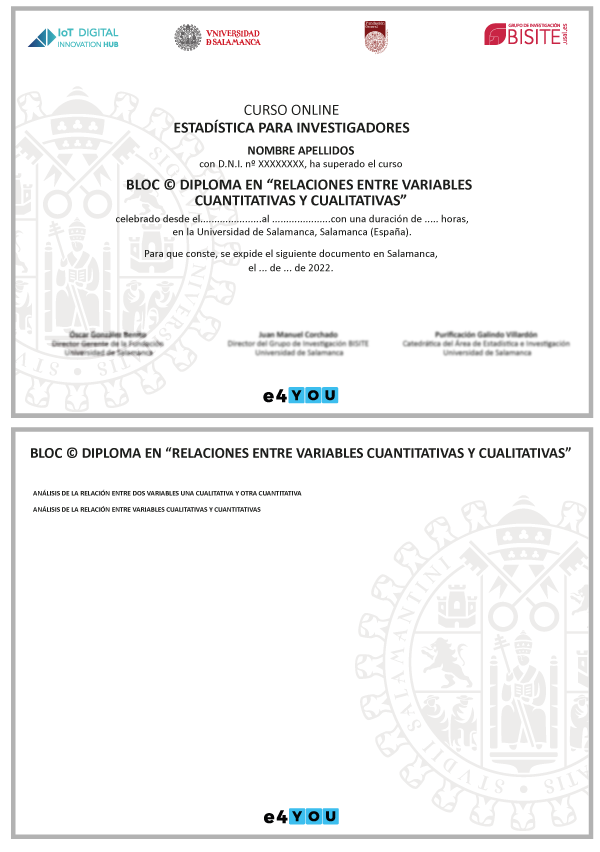
BLOC © Diploma in
"Relationships Between Quantitative and Qualitative Variables"
Certificate you can obtain if you successfully complete the following courses:
- Analysis of the relationship between two variables, one qualitative and one quantitative.
- Analysis of the relationship between quantitative and qualitative variables.
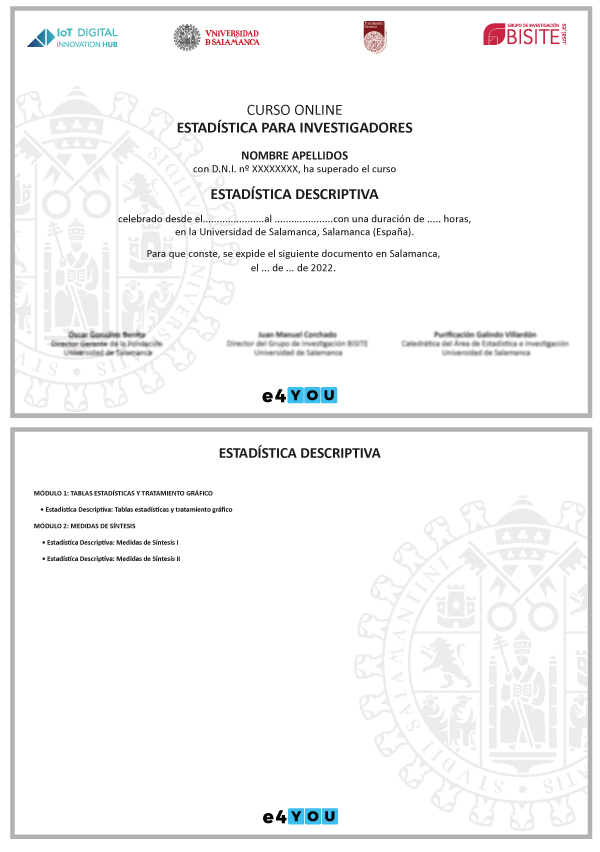
Course certificates offered:
Course Certificate "Descriptive Statistics"
- Each course in the program offers its own certificate. The certificate from one of the courses is used as an example.
Keywords: statistics, researchers, statistical methodology, research, higher education, descriptive statistics, correlation, regression, chi-square test, Student's t-test, nonparametric tests.